Kustom Kulture is the Southern California custom car and art scene that grew out of 1950s hot rodding — the world of pinstriping, airbrushed show cars, and cartoon monsters like Ed “Big Daddy” Roth’s Rat Fink. This guide explains where it came from, who shaped it, and how to collect it today.
Where Kustom Kulture Came From
To understand Kustom Kulture, you have to start in the garages and drive-in parking lots of Los Angeles County in the late 1940s and 1950s. Returning GIs had disposable income, cheap used Fords and Chevys were everywhere, and nobody wanted to drive a stock car that looked like the one next to it. Customizing a car — lowering the suspension, chopping the top, shaving the door handles, adding a candy paint job — was a way to stand out and show off your own handiwork.
The word “kustom” with a K wasn’t an accident. Custom car builders spelled it that way on purpose to separate their one-off, hand-built machines from the mass-produced “custom” accessories sold in catalogs. The K signaled a craft movement, not a bolt-on trend. That spelling stuck and now names the entire subculture.
By 1955, the scene had three overlapping trades feeding each other: pinstripers who hand-painted thin lines on sheet metal, airbrush artists who sprayed murals and flames, and the car builders themselves. A hot rodder would get a candy paint job from one shop, pinstriping from a guy in another garage, and a wild mural from an airbrush artist — then take the finished car to a show to be judged against dozens of others.
The Three Pillars of the Movement
Most historians break early Kustom Kulture into three crafts that grew up side by side. Each one mattered, and each one produced a legend whose name still gets dropped at car shows today.
Pinstriping and Von Dutch
Kenneth Howard, who signed his work “Von Dutch,” is the person most people mean when they say pinstriping was an art form. Born in 1929 and raised in a family that ran a sign shop, Howard was laying freehand lines on motorcycles and cars by the early 1950s. He didn’t use stencils or tape — he pulled a loaded brush in one continuous stroke, which is why his lines look alive rather than printed. He died in 1992, but the “Dutch” name still sells pinstriping brushes, hats, and shirts to this day.
Howard was also famously difficult, which is part of why the myth grew. He signed tools, engines, and even rifles with the same flying-eyeball emblem he painted on gas tanks. That eyeball — a winged human eye — became one of the movement’s most reproduced symbols, and it still shows up on Rat Fink-adjacent merchandise sold today.
Airbrushing and Ed “Big Daddy” Roth
If Von Dutch owned the pinstripe, Ed Roth owned the airbrush. Roth was born in Beverly Hills on March 4, 1932, served in the Air Force, and came back to Southern California determined to make a living drawing the monsters he’d been sketching since he was a kid. He started by airbrushing t-shirts and sweatshirts at car shows in the late 1950s, spraying the designs on the spot while a crowd watched.
Roth’s shirts sold for a few dollars each, but they were the seed of something bigger. The shirts put his style in front of tens of thousands of people at once, and they established the visual language that would define his career: bulging eyes, oversized teeth, drool, exhaust smoke, and a gleefully ugly sense of humor. Roth didn’t draw beautiful cars the way other artists did. He drew ugly, funny, monstrous things — and car people couldn’t get enough of them.
Show Cars and Fiberglass
The third pillar was the show car itself. Before Roth, a custom car was usually a real production car that had been cut, welded, and painted. Roth changed that by building cars almost entirely out of hand-laid fiberglass, a material he adopted because it let him sculpt any shape he could imagine without waiting for Detroit to build it.
His first famous car was The Outlaw, a fiberglass-bodied roadster set on a modified Ford frame. Roth finished it around 1960 and drove it to shows himself. The reaction taught him the core lesson of his career: a wild shape stopped traffic, but a wild shape paired with a name and a character sold t-shirts, posters, and model kits. The Outlaw led directly to the Beatnik Bandit in 1960, a bubble-topped car with a clear plastic canopy and a body so low it looked like it was melting onto the pavement. Car Craft magazine put it on the cover, and Roth became a national name almost overnight.
What Is Rat Fink, Exactly?
Rat Fink is the green, buck-toothed, drooling mouse-monster that Roth drew as an anti-hero to the clean-cut cartoon characters of the early 1960s. Roth created Rat Fink around 1963 as a deliberate opposite of the polished mascots companies used in advertising. Instead of a smiling, friendly animal, Rat Fink had bloodshot eyes, a long tail, and a mouth full of uneven teeth. He was ugly on purpose, and that was the joke.
The character caught on fast. Revell released the first plastic Rat Fink model kit in 1963, and it sold in numbers that surprised even Roth — millions of kits over the following years. The kits let kids (and plenty of adults) build their own Rat Fink at the kitchen table, which is a big reason the character survived long after the original car-show boom faded. Roth kept expanding the cast with spin-off characters, but Rat Fink remained the one people remembered.
Why green, why a mouse, why the drool? Roth never gave one tidy answer, which is part of the appeal. The green paint was just a color he reached for when he was airbrushing shirts. The mouse shape came from his childhood sketchbooks. The drool and the bloodshot eyes were pure attitude — a way to make the character feel hungover, wild, and a little dangerous in an era when most commercial mascots were scrubbed clean. The lack of a neat origin story is itself part of the lore.
From Car Shows to “Lowbrow” Art
By the late 1960s, the original hot-rod show circuit was cooling off, and Roth’s model-kit income had slowed. But the artwork didn’t die — it moved into a new frame. In 1979, painter Robert Williams published The Lowbrow Art of Robert Williams, a book that gave a name to the kind of hot-rod, tattoo, and comic-influenced painting he and artists like Roth had been doing for decades. Williams later co-founded Juxtapoz magazine in 1994, which became the movement’s de facto gallery wall.
“Lowbrow” was originally a joke aimed at the fine-art world that looked down on cartoon-and-car imagery. The artists kept the label and wore it proudly. Today the term and “Kustom Kulture” are used almost interchangeably to describe the same visual family: pinstriping, flames, chrome, cartoon monsters, and the color palette of 1950s candy paint. A Rat Fink print hanging in a gallery and a Rat Fink t-shirt at a car show are both part of the same lineage.
Why Kustom Kulture Still Sells
There’s a practical reason this 1960s aesthetic never fully went away: it’s rooted in real objects and real skills. A pinstriper, an airbrush artist, and a fiberglass car builder all had to actually make something with their hands. That hands-on quality reads through in the finished product in a way that digital, mass-produced graphics don’t. Collectors respond to it because the pieces feel like they came from a person, not a factory.
The second reason is nostalgia with a rebellious edge. A lot of buyers either grew up with the model kits or discovered them through their parents and grandparents. Rat Fink feels like a family heirloom and a middle finger at the same time, which is a rare combination. It’s why a green mouse drawn in 1963 still appears on everything from mugs to jackets in 2026.
How to Start Collecting Kustom Kulture Art
You don’t need a six-figure Roth original to own a piece of the movement. Most collectors start with the same three tiers, and you can enter at any level.
- Prints and posters. Reproductions of Roth’s original Rat Fink art and Von Dutch’s flying eyeball are cheap, easy to frame, and instantly recognizable. They’re the fastest way to put the aesthetic on a wall.
- Objects you actually use. A mug, a tumbler, a phone case, or a backpack with Rat Fink art puts the culture in your daily routine instead of behind glass. These tend to be the best value because you get function plus the artwork.
- Vintage model kits and memorabilia. Original 1960s Revell Rat Fink kits and period t-shirts command real prices on the collector market, but they require condition knowledge and a willingness to spend. Start with the reproductions and work up.
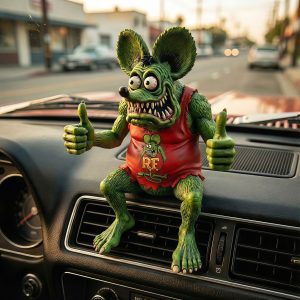
One thing worth knowing before you buy: condition matters a lot on vintage pieces, so read listings carefully, but for new licensed merchandise it matters far less. A modern A Funny Green Mouse Decorative Figurine gives you the exact green, buck-toothed character in a form that sits on a shelf without any restoration worry. It’s the difference between owning a museum piece and owning a piece you can put next to the garage stereo.
What to Look For in New Merchandise
When you’re buying new Kustom Kulture gear rather than vintage, focus on three things. First, the artwork — does the Rat Fink image look like Roth’s actual line work, or a knockoff with the proportions off? Second, the substrate — an 11oz ceramic mug and a thin plastic cup are not the same product, and the price should reflect that. Third, the finish — printed art on a backpack or jacket should be sharp, not blurry, and it should be applied in a way that won’t crack after a season of use.
Size and capacity are concrete ways to judge value. An 11oz coffee mug, a 20oz tumbler, a standard-size phone case, and a daypack with a stated liter capacity all give you something measurable to compare against. If a listing won’t tell you the dimensions or the material, that’s usually a signal to keep looking.
Kustom Kulture and Hot Rod Culture Are the Same Roots
People sometimes treat Kustom Kulture and hot rod culture as two separate things, but they’re the same trunk with different branches. Hot rodding is the mechanical act — building, modifying, and racing cars. Kustom Kulture is the visual and artistic layer that grew around it: the paint, the pin lines, the murals, and the cartoon characters that advertised the whole scene. You can’t really understand the art without the cars, and the cars look half-finished without the art.
That’s why the two categories are always sold side by side. A garage wall that holds a hot rod calendar and a Rat Fink poster is displaying two halves of the same hobby. A Kustom Legend Commemorative Wall Bell is a good example of a piece that sits right on that line — it’s a functional garage object that’s also a piece of lowbrow art, the same way the original show cars were machines that doubled as sculptures.
Frequently Asked Questions About Kustom Kulture
Who invented Kustom Kulture?
No single person invented it, but Ed “Big Daddy” Roth is the name most often credited with turning it into a recognizable style. Von Dutch (Kenneth Howard) built the pinstriping half, and Robert Williams later gave the art form its “lowbrow” label, but Roth’s Rat Fink is the image that most people picture when they hear the phrase.
Is Rat Fink a mouse or a rat?
Despite the name, Rat Fink is drawn as a mouse — Roth based the character on his childhood mouse sketches. The “rat” in the name is a nod to hot-rod slang and to the character’s scruffy, troublemaking attitude, not a literal species description.
When was Rat Fink created?
Rat Fink first appeared around 1963, the same year Revell released the first plastic model kit of the character. The kit’s success is what turned a shirt design into a lasting icon.
Is Kustom Kulture the same as lowbrow art?
They overlap heavily but aren’t perfectly identical. Lowbrow art is the broader painting movement Robert Williams named in 1979, covering hot rods, tattoo imagery, and comic art. Kustom Kulture is the specific custom-car branch of that world, centered on pinstriping, airbrushing, and show cars.
Why do people still collect Rat Fink in 2026?
Because the character sits at the intersection of three durable things: car culture, nostalgia, and a visual style that never became mainstream enough to feel corporate. Owning a Rat Fink piece is a way to signal membership in a hobby that has stayed small and specific for sixty years.
Bring a Piece of Kustom Kulture Home
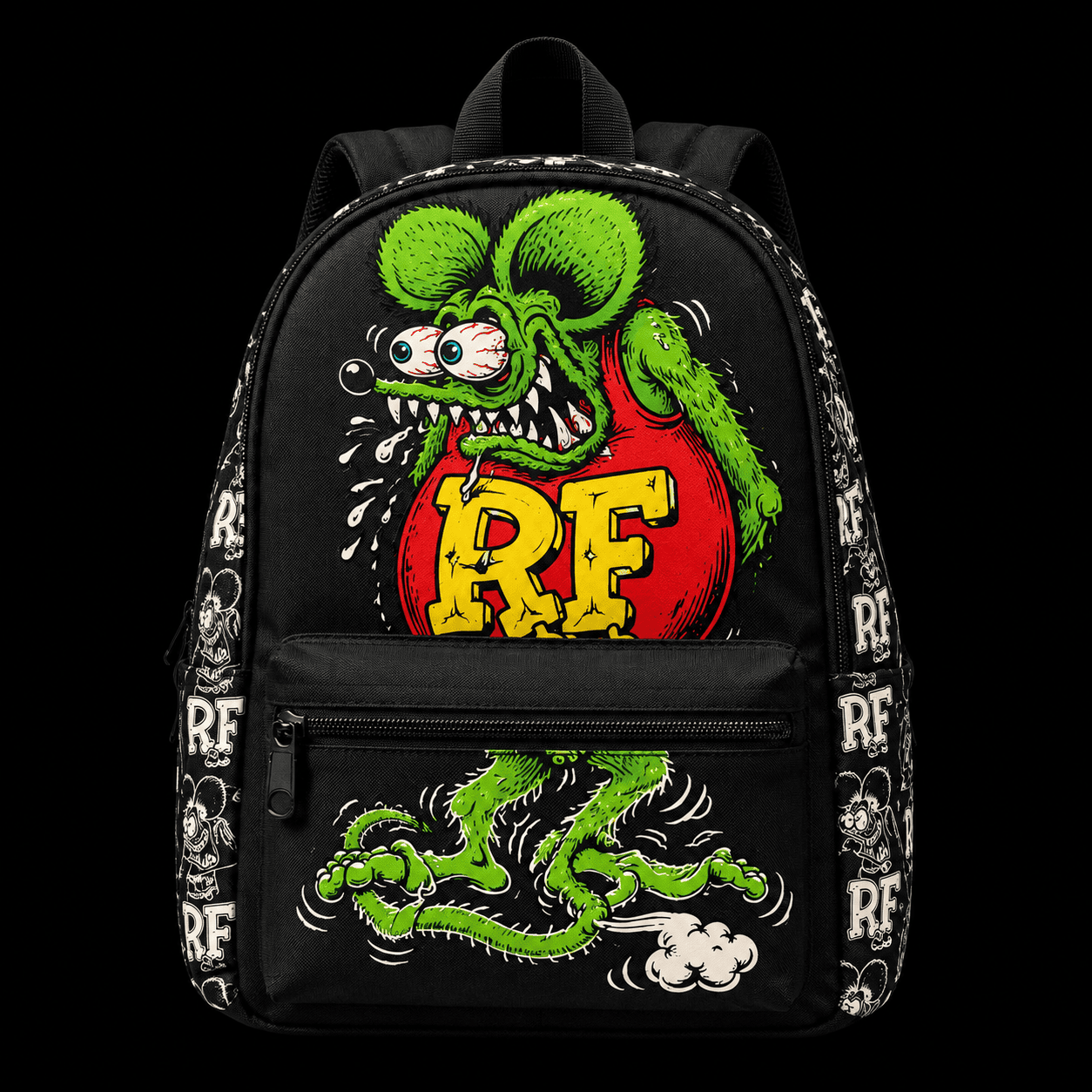
If this is your first time buying into the movement, start with something you’ll actually see every day rather than something that hides in a drawer. A printed backpack, a shelf figurine, or a wall piece gives you the art in a form you’ll notice, which is the whole point of a visual culture. For a wearable way to carry the lowbrow look, the Rat Fink Kustom Kulture Backpack puts a full-art panel on a daypack you can use for work, the gym, or the next car show. Whatever you pick, buy the artwork you like, not the piece you think will impress a forum — that’s the attitude the original Kustom Kulture builders had, and it’s still the right one.